
Fine Hair vs. Thinning Hair: What's the Difference?
Fine Hair vs. Thinning Hair: What's the Difference?
"Is my hair just naturally fine, or is it actually thinning?" It's one of the most common — and most confusing — questions people ask when they start paying closer attention to their hair. The comparison of thinning hair vs fine hair trips up a lot of people, because the two can look similar at a glance but come from completely different places, and they call for different approaches.
This guide breaks down exactly what separates naturally fine hair from genuine hair thinning, how to figure out which one applies to you, and what a smart, supportive routine looks like for each.
Table of Contents
What Is Fine Hair?
Fine hair is a natural hair characteristic, not a condition or a sign that something is wrong. It refers specifically to the diameter of each individual hair strand.
Hair Strand Diameter
Hair is generally categorized as fine, medium, or coarse based on the width of each strand. Fine hair strands are simply narrower in diameter than medium or coarse strands — often compared to the width of a single thread of sewing silk versus something closer to fishing line for coarser hair types.
Genetics
Strand diameter is largely determined by genetics, the same way eye color or natural hair texture is. If your parents or grandparents had fine hair, there's a good chance you inherited that same characteristic, regardless of how healthy your scalp or hair follicles are.
Natural Hair Characteristics
Fine hair often comes with a few recognizable traits:
- Strands that feel silky or delicate to the touch
- Hair that can appear flatter or less voluminous, especially when grown long
- A tendency to look weighed down by heavy products
- Hair that may tangle less due to a smoother strand surface
Importantly, fine hair can still be dense — meaning you can have a lot of naturally thin strands packed closely together, which is a very different situation from having fewer strands overall.
What Is Hair Thinning?
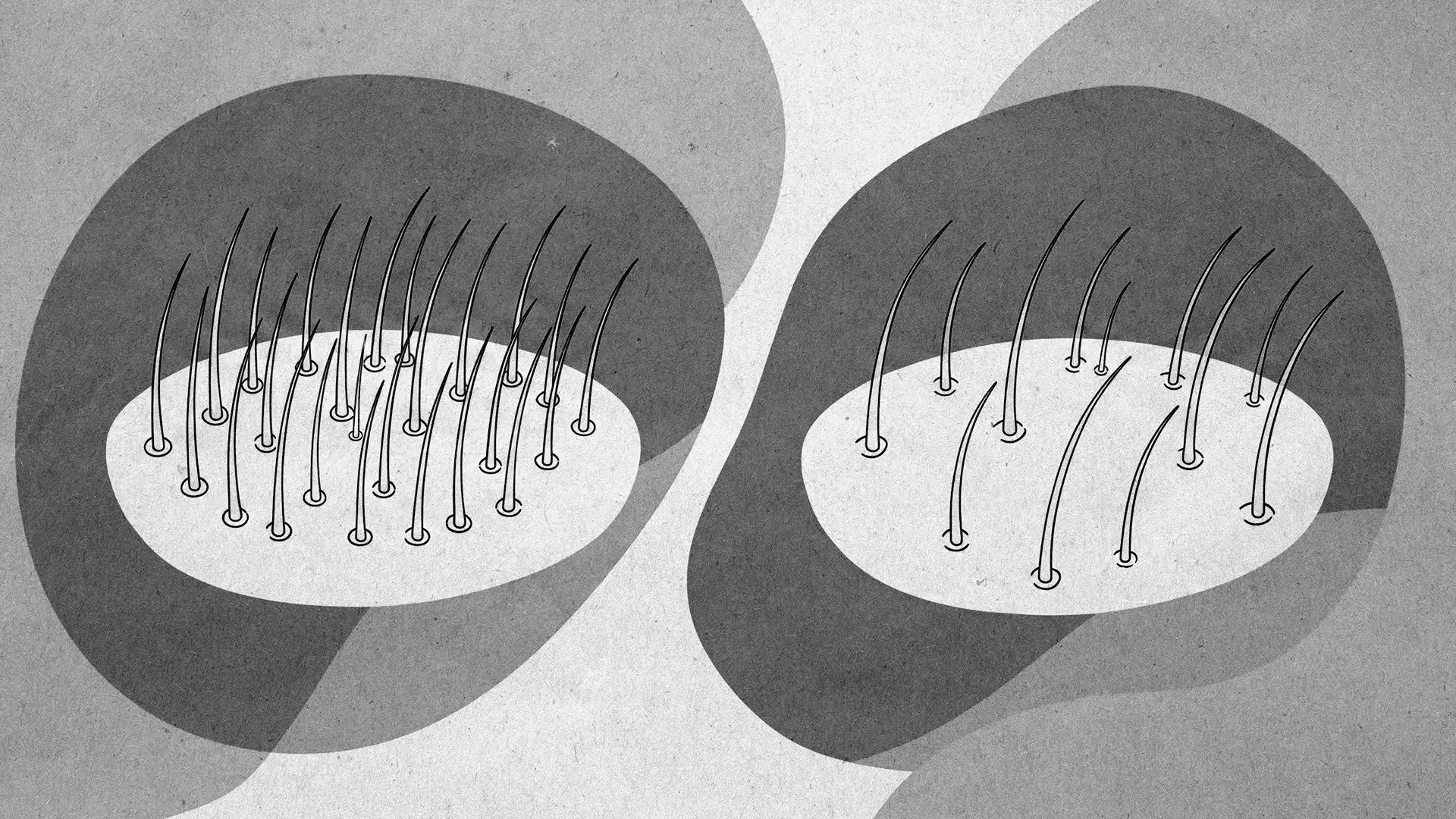
Hair thinning, by contrast, refers to a change over time — a reduction in the overall amount or density of hair, rather than a fixed characteristic you were born with.
Reduced Hair Density
Density refers to how many hairs are present per square inch of scalp. Thinning happens when this number decreases, meaning there's simply less hair covering the same area than there used to be.
Hair Follicle Miniaturization
In many cases of progressive thinning, individual hair follicles shrink over time — a process called miniaturization — producing progressively finer, shorter hairs with each growth cycle, sometimes eventually stopping hair production in that follicle altogether.
Hair Loss
At its more advanced stages, thinning can progress into more noticeable hair loss, including a receding hairline, widening part, or visibly balding patches, depending on the underlying cause.
Shedding
Hair thinning is often accompanied by an increase in daily shedding — noticeably more hair than the typical 50–100 strands most people lose per day — which is one of the clearest early indicators that something beyond natural fineness is happening. To dig deeper into specific causes, see our guide on why hair thins.
Fine Hair vs. Thinning Hair: A Detailed Comparison
How to Tell Which One You Have
Signs of Naturally Fine Hair
- Your hair has felt this way for as long as you can remember, without a noticeable change
- Family members share a similar hair texture
- Your hair density (how much hair you have) still feels relatively full, even though each strand feels delicate
- You don't notice significantly more hair in your brush, shower, or on your pillow than you remember from years ago
Signs of Hair Thinning
- A noticeable change compared to how your hair looked or felt in the past
- Increasing visibility of your scalp, especially at the part line or crown
- More hair than usual collecting in your brush, shower drain, or on your pillow
- Your ponytail feels visibly smaller in circumference than it used to
- Photos from a year or more ago show a visibly fuller hairline or crown compared to now
Self-Check Methods
- The ponytail test: Wrap a hair tie around your ponytail as many times as it takes to feel secure, and note the number. Repeat this every few months — needing more wraps over time can indicate reduced density.
- The part-width photo test: Take a photo of your part from the same angle and lighting every month. Gradual widening over several months suggests thinning rather than a fixed trait.
- The pull test: Gently pull a small section of hair (about 20-30 strands) and count how many come away in your hand. Losing more than a few could suggest active shedding, though this test is best interpreted alongside other signs rather than in isolation.
Professional Diagnosis
If you're still unsure, a dermatologist can offer a much more reliable answer than self-assessment. They may use tools like a dermatoscope to examine follicle density directly, or run bloodwork to check for underlying nutritional or hormonal contributors. This is especially worth pursuing if you're noticing rapid changes, patchy areas, or scalp irritation alongside the change in hair appearance.
Common Causes of Hair Thinning
Unlike fine hair, which is simply how your hair grows, thinning hair usually has an identifiable, sometimes changeable, cause.
Stress
Significant physical or emotional stress can trigger a temporary shedding phase called telogen effluvium, in which hair loss becomes noticeable roughly two to three months after the stressful event.
Hormones
Hormonal shifts — including those related to pregnancy, postpartum recovery, menopause, PCOS, or thyroid conditions — can all contribute to changes in hair density over time.
Nutrition
Deficiencies in protein, iron, vitamin D, or zinc are commonly linked to increased shedding and reduced hair density.
DHT
In genetically predisposed individuals, the hormone DHT is associated with gradual follicle miniaturization, a key driver of androgenetic alopecia (pattern hair thinning). Our guide on DHT and hair loss covers this mechanism in more detail.
Medical Conditions
Certain autoimmune conditions, thyroid disorders, and other underlying health issues can present with hair thinning as one of several symptoms.
Lifestyle
Harsh styling practices, chronic poor sleep, smoking, and excessive alcohol intake can all compound or accelerate visible thinning over time.
Can Fine Hair Become Thin?
Yes — and this is exactly where the confusion often comes from. Having naturally fine hair doesn't protect you from also experiencing hair thinning later in life. In fact, because fine hair already has a lower "visual mass" per strand, any additional reduction in density can become noticeable more quickly than it might on someone with naturally coarser hair.
This means someone with naturally fine hair should pay just as much attention to the signs of thinning outlined above — increasing scalp visibility, more shedding than usual, or a shrinking ponytail circumference — rather than assuming their hair has "always looked this way" without checking.
Best Hair Care Routine for Fine Hair
Morning
- Use a lightweight, volumizing shampoo that won't weigh strands down
- Apply styling products sparingly, focusing on roots rather than full lengths
- Avoid heavy oils or creams that can flatten fine hair
Night
- Loosely braid or tie hair to prevent tangling without adding tension
- Use a silk or satin pillowcase to reduce friction and frizz
- Avoid sleeping with wet hair, which is more prone to breakage
Weekly
- Use a clarifying shampoo occasionally to prevent product buildup, which can weigh fine hair down more noticeably than other hair types
- Consider a lightweight, volumizing mask rather than a heavy deep-conditioning treatment
- Trim regularly to prevent thin, fragile ends from splitting further up the strand
Best Hair Care Routine for Thinning Hair
Morning
- Use a gentle, scalp-focused shampoo formulated to support a healthy follicle environment
- Prioritize a protein-rich breakfast to support keratin production
- Handle hair gently while brushing, working from the ends upward
Night
- Cleanse gently on wash days, focusing on the scalp rather than just the lengths
- Apply a targeted scalp serum to a clean scalp
- Spend a few minutes on gentle scalp massage to support circulation and unwind before bed
Weekly
- Track shedding and scalp condition to monitor whether thinning is stable, improving, or progressing
- Use a gentle exfoliating step if buildup is a concern
- Reassess styling habits, avoiding repeated tight hairstyles
For a more complete, general framework covering both morning and night routines in depth, see our full hair growth routine guide.
Common Mistakes People Make
- Assuming fine hair and thinning hair are the same thing without checking for actual changes over time
- Using heavy, weighing-down products on fine hair and blaming the result on thinning
- Ignoring gradual changes in scalp visibility because "my hair has always been fine"
- Jumping to expensive treatments before confirming whether thinning is actually occurring
- Overwashing fine hair in an attempt to add volume, which can dry out the scalp
- Underwashing a thinning-prone scalp, allowing buildup to accumulate
- Applying heavy oils directly to fine hair roots, flattening natural volume
- Skipping regular trims, allowing fragile fine-hair ends to split further
- Wearing tight hairstyles daily on hair that's already showing signs of thinning
- Comparing your hair to someone else's without accounting for different natural hair types
- Not tracking density changes with photos, relying on memory alone
- Assuming thinning is always permanent or untreatable
- Delaying a dermatologist visit despite noticeable, rapid changes
- Using the same routine for fine hair and thinning hair, when their needs are different
- Focusing only on topical products while ignoring nutrition, stress, and sleep
Myths vs. Facts
How Scalp Health Helps Both
Whether you have naturally fine hair or hair that's actively thinning, the health of your scalp plays a meaningful supporting role either way. A clean, balanced, well-cared-for scalp:
- Supports the healthiest possible environment for whatever hair you have to grow well
- Helps prevent additional issues like buildup, irritation, or inflammation from compounding existing concerns
- Provides a stable foundation that makes it easier to notice and track genuine changes in density over time
- Supports the effectiveness of any targeted products you use, since a compromised scalp can undermine even well-formulated ingredients
This is why scalp care is often the most universally useful starting point, regardless of which category — fine or thinning — your hair falls into.
How Scalvea Fits Into a Healthy Routine
Because fine hair and thinning hair call for somewhat different approaches, the right routine depends on which one you're actually dealing with — but a healthy, well-supported scalp benefits both.
The Scalvea Hair Growth Shampoo is formulated to gently cleanse the scalp without weighing hair down, making it a suitable choice whether you're managing naturally fine hair or supporting a scalp affected by thinning. The Scalvea Hair Growth Serum is designed to be applied to a clean scalp as a targeted step, with ingredients selected to support a healthy scalp environment as part of a consistent routine.
Neither product changes your natural strand diameter, and neither guarantees regrowth for thinning hair. They're formulated to support the healthiest possible scalp conditions — helping your hair, whatever its natural characteristics, look and feel its best as part of a broader, realistic routine. For a deeper look at the ingredients behind formulations like these, see our guide to the best ingredients for hair regrowth.
Key Takeaways
- Fine hair refers to the natural diameter of individual strands and is primarily determined by genetics — it's a stable trait, not a condition.
- Hair thinning refers to a reduction in overall hair density over time, often linked to genetics, hormones, stress, nutrition, or scalp health.
- The clearest way to tell them apart is by noticing change over time — fine hair has always felt that way, while thinning hair represents a shift from your own baseline.
- Simple self-check methods, like the ponytail test and part-width photo tracking, can help clarify which one applies to you.
- Fine hair and thinning hair benefit from different routines — lightweight volumizing care for fine hair, and scalp-focused, cause-specific support for thinning hair.
- Scalp health remains a valuable, supportive foundation regardless of which category your hair falls into.
- Products like the Scalvea Hair Growth Shampoo and Scalvea Hair Growth Serum are designed to support a healthy scalp environment as part of either routine, without overpromising results.
Frequently Asked Questions
1. What is the difference between fine hair and thinning hair? Fine hair refers to a naturally narrow strand diameter that's present throughout life, while thinning hair refers to a decrease in overall hair density that develops or progresses over time.
2. How do I know if I have fine hair or thinning hair? Look for changes over time — if your hair has always felt this way with no noticeable shift, it's likely naturally fine; if you're seeing more scalp, more shedding, or a shrinking ponytail, it may be thinning.
3. Can fine hair turn into thinning hair? Yes, naturally fine hair can also experience thinning due to genetics, hormones, stress, or other factors, and because fine hair has less "visual mass" per strand, thinning can become noticeable more quickly.
4. Is fine hair a sign of hair loss? No, fine hair is a natural genetic trait related to strand diameter and isn't itself an indicator of hair loss or poor scalp health.
5. What causes hair to become thinner over time? Common causes include genetics and DHT sensitivity, hormonal changes, chronic stress, nutritional deficiencies, and certain medical or scalp conditions.
6. Does fine hair need a different shampoo than thinning hair? Yes, fine hair generally benefits from lightweight, volumizing formulas, while thinning hair benefits more from scalp-focused shampoos designed to support a healthy follicle environment.
7. Can I have fine hair and high hair density at the same time? Yes, hair diameter (fineness) and hair density (how many strands you have) are independent factors — you can have many naturally fine strands, resulting in hair that still looks full.
8. How can I test if my hair is thinning? Simple self-check methods include tracking ponytail circumference over time, photographing your part from the same angle monthly, and gently performing a pull test to gauge shedding.
9. Is it normal for hair density to decrease with age? Yes, some reduction in hair density is a natural part of aging for most people, though the pace and visibility vary significantly from person to person.
10. Can stress cause fine hair to look thinner? Yes, stress-related shedding (telogen effluvium) can affect anyone, including those with naturally fine hair, making already-delicate strands appear even sparser during a shedding episode.
11. What's the best routine for fine, thinning hair specifically? A routine combining lightweight, volumizing products with scalp-focused care — like gentle cleansing and a targeted serum — can help address both the natural fineness and any underlying thinning.
12. Does fine hair fall out more easily than thick hair? Fine hair isn't necessarily more prone to falling out, but because each strand is thinner, any given amount of shedding can be more visually noticeable.
13. Can hair thinning be reversed if caught early? Depending on the cause, early identification and consistent, cause-specific care can often help slow or stabilize thinning, though outcomes vary by individual and underlying cause.
14. Should I see a dermatologist to know if my hair is thinning? Yes, a dermatologist can offer a much more precise assessment than self-observation, especially if changes seem rapid, patchy, or accompanied by other symptoms.
15. Do styling products make fine hair look thinner? Heavy oils, creams, or overly rich conditioners can weigh fine hair down, making it appear flatter and thinner than it naturally is.
16. Is thinning hair always a medical condition? Not necessarily — some thinning is temporary (like stress-related shedding) and resolves on its own, while other cases may benefit from medical evaluation depending on severity and cause.
17. Can genetics cause both fine hair and hair thinning? Yes, genetics can independently influence both natural strand diameter (fine hair) and susceptibility to progressive thinning (like androgenetic alopecia), meaning some people experience both.
18. Does a hair growth serum work for naturally fine hair? A hair growth serum designed for scalp health can support fine hair's overall condition, though it won't change the natural diameter of each strand.
19. What's the biggest visual difference between fine hair and thinning hair? Fine hair typically shows a soft, delicate strand texture with density that has remained relatively stable, while thinning hair often shows increasing scalp visibility and a shrinking ponytail or part width over time.
20. How often should I reassess whether my hair is thinning versus naturally fine? Checking every few months using consistent methods, like the same-angle part photo or ponytail wrap count, offers a reliable way to track whether meaningful change is occurring over time.
This article is for informational purposes and is not a substitute for professional medical advice. If you're concerned about changes in your hair density, consult a dermatologist for a proper evaluation.