Does Saw Palmetto Actually Work for Hair Growth? The Science Explained
Does Saw Palmetto Actually Work for Hair Growth? The Science Explained
If you've spent any time researching natural options for hair thinning, you've almost certainly come across saw palmetto. It's marketed as a "natural DHT blocker," sold in supplements, shampoos, and serums, and often positioned as a gentler alternative to prescription treatments. But does saw palmetto help hair growth, or is it mostly marketing built on thin evidence?
This guide walks through what saw palmetto actually is, how it's believed to work, what the clinical research says so far, and how it compares to established treatments like minoxidil and finasteride. The goal isn't to oversell or dismiss it — it's to give you a clear, evidence-based picture so you can decide whether it belongs in your routine.
Table of Contents
What Is Saw Palmetto?
Saw palmetto (scientific name Serenoa repens) is a small, fan-leafed palm plant. Its berries have been used for centuries, most notably in traditional remedies aimed at supporting prostate and urinary health in men. In more recent decades, researchers and hair care formulators became interested in a different property of the plant: its potential effect on a hormone called DHT, which plays a central role in genetic hair thinning.
Today, saw palmetto shows up in the hair care world in a few different forms:
- Oral supplements (capsules or softgels containing saw palmetto extract)
- Topical serums and oils formulated for direct scalp application
- Shampoo formulations, where it's included alongside other scalp-supporting ingredients
Each delivery method has a different level of evidence behind it, which we'll get into shortly.
Where Does Saw Palmetto Come From?
Saw palmetto is native to the southeastern United States, particularly Florida, where it grows along coastal plains. The plant produces dark purple-black berries, which are harvested and processed into extract form. This extract is typically standardized to contain a specific concentration of fatty acids and phytosterols — the compounds believed to be responsible for its biological activity.
Because the berries have a long history of traditional use, saw palmetto has generally been well tolerated in studies, which is part of why it continues to attract research interest as a "natural" option in the hair loss space.
Why Is DHT So Important in Hair Loss?
To understand why saw palmetto is relevant to hair growth at all, it helps to understand the hormone at the center of the conversation: DHT.
Testosterone and DHT
Testosterone is a hormone present in both men and women, though at different levels. An enzyme called 5-alpha reductase converts a portion of testosterone into DHT (dihydrotestosterone), a more potent androgen.
Follicle Miniaturization
In people who are genetically predisposed, hair follicles on the scalp are especially sensitive to DHT. Over time, repeated exposure is associated with a process called follicle miniaturization — each affected follicle produces progressively finer, shorter, and less pigmented hair, until in some cases it stops producing visible hair.
Genetics
Sensitivity to DHT is inherited, and this genetic predisposition — not DHT levels alone — largely determines whether a person develops pattern hair loss and how early it begins. This is why two people with similar hormone levels can have very different hair outcomes.
Male Pattern Hair Loss
In men, DHT-driven thinning typically follows a recognizable pattern: a receding hairline and thinning at the crown, which can progress over years.
Female Pattern Thinning
In women, the picture is a little different. While DHT can still play a role, hormonal fluctuations more broadly — including estrogen changes — often contribute to diffuse thinning and a widening part, rather than a receding hairline.
This is the backdrop against which saw palmetto is studied: as a potential way to interfere with the DHT pathway, without the prescription-strength effects of drugs specifically designed for that purpose. For a deeper look at this mechanism, see our guide on DHT and hair loss.
How Saw Palmetto May Work
Inhibiting 5-Alpha Reductase
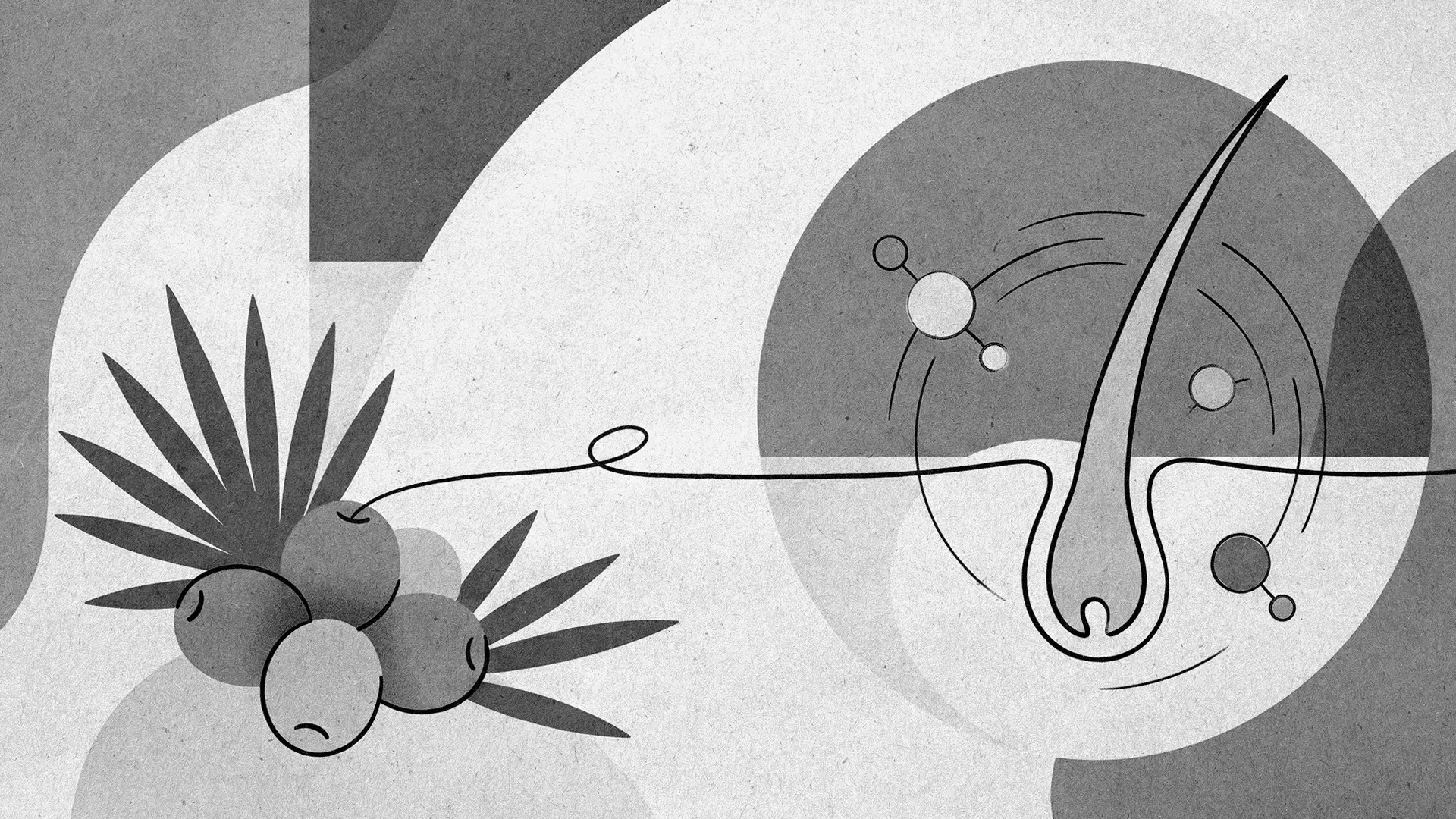
The leading theory behind saw palmetto's effect on hair is that certain compounds in the extract — primarily fatty acids and phytosterols — may partially inhibit the 5-alpha reductase enzyme. Since this enzyme is responsible for converting testosterone into DHT, partially blocking it could theoretically reduce the amount of DHT available to affect sensitive hair follicles.
Research-Supported Mechanisms
Laboratory (in vitro) studies have shown that saw palmetto extract can inhibit 5-alpha reductase activity to some degree. This gives a plausible biological basis for why it might help with DHT-driven hair thinning — but a lab finding is very different from a proven clinical outcome in real people.
Current Evidence
Human clinical studies on saw palmetto for hair loss exist, but they are relatively few, often small in scale, and vary in study design and quality. Several trials have reported modest improvements in hair density or patient-reported satisfaction among people using saw palmetto compared to a placebo. However, the effect sizes reported are generally smaller than those seen with established treatments like finasteride.
Limitations of the Evidence
It's important to be direct about the current state of research:
- Many existing studies have small sample sizes
- Study durations are often shorter than what's typically needed to fully assess hair growth changes
- Formulations, dosages, and delivery methods (oral vs. topical) vary significantly between studies, making it hard to compare results directly
- Few large-scale, long-term, placebo-controlled trials exist compared to prescription treatments
In short: saw palmetto has a plausible mechanism and some supportive early evidence, but it is not yet backed by the same depth of research as clinically established hair loss treatments.
Scientific Research on Saw Palmetto and Hair Growth
Here's a plain-language summary of what research has generally explored, without overstating the findings.
Oral supplementation studies: Several small trials have examined saw palmetto extract taken orally over periods of several months. A number of these studies reported that a portion of participants experienced improved hair density or reduced shedding compared to those taking a placebo, based on both clinical measurements and self-assessment.
Comparative studies: A smaller number of studies have directly compared saw palmetto to finasteride. Findings generally suggest that while some participants saw improvement with saw palmetto, the response was typically less pronounced than with finasteride, which has a much stronger and more consistent evidence base.
What researchers found: Early, modest evidence that saw palmetto may help reduce hair loss progression or modestly support hair density in some individuals with androgenetic alopecia.
What remains uncertain:
- The ideal dosage and formulation for hair-specific benefits
- Whether topical application delivers meaningful results compared to oral intake
- Long-term effectiveness beyond the study periods typically examined
- How effective it is for female pattern hair loss specifically, since most existing research has focused on men
Who may benefit: Based on current evidence, saw palmetto may be most relevant for people with mild-to-moderate androgenetic alopecia who are looking for a gentler, lower-risk option to explore, ideally alongside — not instead of — broader scalp care and lifestyle habits.
Saw Palmetto vs. Minoxidil
Saw Palmetto vs. Finasteride
Key takeaway: Saw palmetto is generally considered a milder, lower-risk option with a much thinner evidence base, while finasteride is a clinically proven but prescription-only treatment that carries a distinct side-effect profile. Neither should be chosen without understanding the trade-offs, and finasteride specifically should only be used under medical guidance.
Does Topical Saw Palmetto Work?
Topical application — applying saw palmetto directly to the scalp via a serum or oil — is theoretically appealing because it targets the follicle directly rather than passing through the digestive system.
However, research on topical saw palmetto specifically is even more limited than research on oral supplementation. Some small studies and formulator-led evaluations suggest topical use may be well tolerated and could offer localized benefits, but robust, independent clinical trials on topical-only application are still lacking.
This doesn't mean topical saw palmetto is ineffective — it simply means the evidence is still developing, and claims about topical-specific results should be treated with appropriate caution.
Who Should Consider Saw Palmetto?
Saw palmetto may be worth exploring for:
- People with early-stage, mild androgenetic alopecia looking for a gentler starting point
- Those who want to avoid prescription medications due to personal preference or side-effect concerns
- People already using other evidence-based approaches (like a healthy scalp routine) who want to add a low-risk supportive ingredient
- Individuals looking for options to discuss with a dermatologist as part of a broader hair health plan
Who Should Avoid It?
Saw palmetto isn't right for everyone. It's generally advisable to avoid or discuss with a doctor first if you:
- Are pregnant or breastfeeding
- Are taking blood-thinning medications, since saw palmetto may have mild anticoagulant properties
- Are scheduled for surgery in the near future
- Are already taking other hormone-related medications, due to potential interactions
- Have a known allergy to plants in the same family
As with any supplement, it's worth having a conversation with a healthcare provider before starting, especially if you have existing health conditions or take other medications.
Common Mistakes People Make With Saw Palmetto
- ❌ Expecting dramatic regrowth within a few weeks
- ❌ Using it as a total replacement for medical evaluation of hair loss
- ❌ Choosing low-quality, non-standardized supplements with unclear extract concentrations
- ❌ Combining it with multiple other new products at once, making it impossible to track what's working
- ❌ Ignoring scalp health fundamentals while focusing only on one ingredient
- ❌ Discontinuing use after just a few weeks due to lack of instant results
- ❌ Not consulting a doctor despite being on other medications
Myths vs. Facts About Saw Palmetto
How to Build a Hair Routine Around Scalp Health
Whether or not saw palmetto becomes part of your routine, the foundation of any hair care strategy remains the same: a healthy, well-cared-for scalp.
A supportive routine typically includes:
- Gentle, consistent cleansing to remove buildup, oil, and product residue without stripping the scalp
- Targeted scalp treatment, applied to a clean scalp to give active ingredients the best chance to work
- Reduced mechanical and chemical stress on hair — going easier on heat styling, tight hairstyles, and harsh chemical treatments
- Patience and consistency, since any hair care ingredient — natural or prescription — needs several months of steady use before results can be fairly assessed
This is where a considered, scalp-first routine comes in. The Scalvea Hair Growth Shampoo is formulated to gently cleanse the scalp and help clear the kind of buildup that can interfere with a healthy follicle environment, while the Scalvea Hair Growth Serum is designed to be applied directly to a clean scalp as a targeted step in your routine, with ingredients selected to support scalp health as part of consistent, long-term care.
Neither product is positioned as a guaranteed regrowth solution or a replacement for medical treatment — they're formulated to complement a broader, evidence-informed approach to hair care, alongside the fundamentals covered throughout this guide. For ingredient comparisons across the hair growth category, see our breakdown of the best ingredients for hair regrowth, and for a full step-by-step approach, check out our hair growth routine guide.
Key Takeaways
- Saw palmetto is a plant extract studied for its potential to mildly inhibit 5-alpha reductase, the enzyme responsible for converting testosterone into DHT.
- Early research shows modest, promising results for some people with mild-to-moderate androgenetic alopecia, but the evidence base is much smaller than for minoxidil or finasteride.
- Saw palmetto is generally milder and lower-risk than finasteride, but also less proven in large-scale clinical trials.
- Topical saw palmetto is theoretically appealing but has even less dedicated research than oral supplementation.
- It's not a guaranteed regrowth solution, and results — if any — typically require months of consistent use to assess.
- A consistent, scalp-focused routine remains the foundation of hair health, with saw palmetto as one possible supportive addition rather than a standalone fix.
Frequently Asked Questions
1. Does saw palmetto actually help with hair growth? Some early clinical research suggests saw palmetto may modestly help slow hair thinning in certain individuals, though the evidence is still limited compared to established treatments like finasteride.
2. How does saw palmetto work for hair loss? It's believed to work by partially inhibiting the 5-alpha reductase enzyme, which is responsible for converting testosterone into DHT, a hormone linked to genetic hair thinning.
3. Is saw palmetto as effective as finasteride? No, current research generally suggests finasteride has a stronger and more consistently proven effect on reducing DHT and slowing hair loss compared to saw palmetto.
4. Can women use saw palmetto for hair thinning? Some women use saw palmetto for hormonal hair thinning, but research specifically on women is limited, so it's worth discussing with a doctor first, especially if pregnant or breastfeeding.
5. How long does it take for saw palmetto to work? Because hair grows in cycles, most sources suggest allowing at least 3 to 6 months of consistent use before evaluating any noticeable change.
6. Is saw palmetto safe to use daily? Saw palmetto is generally considered well tolerated for regular use, though anyone with health conditions or on medications should consult a doctor before starting.
7. Can I use saw palmetto and minoxidil together? Many people do combine natural and topical treatments, but it's best to check with a healthcare provider to ensure there are no interactions or unnecessary redundancy.
8. Does topical saw palmetto work better than oral supplements? There isn't enough independent research to say definitively; each delivery method has a different, and still limited, evidence base.
9. What are the side effects of saw palmetto? Reported side effects are generally mild and can include occasional stomach upset; serious side effects are uncommon but possible interactions with certain medications exist.
10. Is saw palmetto a natural DHT blocker? It's often referred to this way because lab studies show it can partially inhibit the enzyme responsible for DHT production, though its real-world effect is milder than prescription DHT blockers.
11. Can saw palmetto regrow hair in bald spots? There is no strong evidence that saw palmetto can regrow hair in areas where follicles have become fully dormant.
12. Is saw palmetto FDA-approved for hair loss? No, saw palmetto is not FDA-approved specifically as a hair loss treatment; it's typically sold and used as a supplement or cosmetic ingredient.
13. Who should avoid taking saw palmetto? People who are pregnant or breastfeeding, taking blood thinners, or on other hormone-related medications should consult a doctor before use.
14. Does saw palmetto help with both male and female pattern hair loss? Most existing research has focused on men, so its effectiveness for female pattern hair loss is less clearly established.
15. Can I combine saw palmetto with a hair growth shampoo and serum? Yes, many people incorporate saw palmetto alongside a broader scalp care routine, including gentle shampoos and targeted serums, as part of a comprehensive approach.
16. Is there a recommended dosage for saw palmetto supplements? Studies have used varying dosages, and there isn't yet a single, universally agreed-upon standard, which is why consulting a healthcare provider is recommended.
17. Does saw palmetto interact with other medications? It may interact with blood thinners and certain hormone-related medications, so it's important to disclose any supplement use to your doctor.
18. Is saw palmetto better for early-stage hair thinning? Current evidence suggests it may be more relevant for mild-to-moderate thinning rather than advanced hair loss, though individual results vary.
19. How is saw palmetto extracted for supplements and serums? It's typically extracted from the berries of the saw palmetto plant and standardized to a specific concentration of fatty acids and phytosterols.
20. Should I see a dermatologist before trying saw palmetto? Yes, a dermatologist can help confirm the underlying cause of your hair thinning and advise whether saw palmetto is a reasonable option within your broader treatment plan.
This article is for informational purposes and is not a substitute for professional medical advice. Consult a dermatologist or healthcare provider before starting any new supplement or hair loss treatment.